Prepare the chemical list
Include chemical names, concentrations, quantities and SDS.
 Request a Quote
Corrosive chemical storage
Compare acid and alkali cabinet options by chemical, concentration, cabinet material and required capacity.
Cabinet material must be reviewed against the chemicals being stored. Send the chemical list and SDS before requesting a model recommendation.
Decision path
The selected cabinet still depends on the stored material, dimensions, quantity and project documents.
Include chemical names, concentrations, quantities and SDS.
Compare the listed construction against the stored chemicals.
List bottle sizes, shelf needs and available floor space.
Ask for model specifications, drawings and material information.
Application fit
Bottled acids or bases stored near routine testing and preparation work.
Corrosive reagents and process samples organized by compatibility group.
Acids, alkalis and treatment reagents held in defined quantities for analysis.
Packaged corrosives separated from flammables, oxidizers and other incompatible materials under the site plan.
Configuration guide
These routes narrow the search. Confirm dimensions, construction and available features on the selected model.
Review the exact chemical, concentration, temperature and container; PP is not universally compatible.
Confirm whether corrosive vapor or spills can contact the cabinet body, shelves or hardware.
Do not use spare shelf space as the basis for combining incompatible materials.
Size containment around bottle dimensions and the facility spill-control procedure.
Selection conditions
Use the table to compare cabinet routes before choosing a model. Final chemical compatibility and site approval remain part of the facility review.
Scope
Use another route when
Common mistakes
Alphabetical order can place incompatible chemicals together; use the approved compatibility plan.
Organic acids, oxidizing acids and other corrosives may require different separation decisions.
No construction material should be treated as universally compatible without chemical-specific review.
A corrosive chemical may also be flammable, oxidizing, water-reactive or otherwise restricted.
Product route
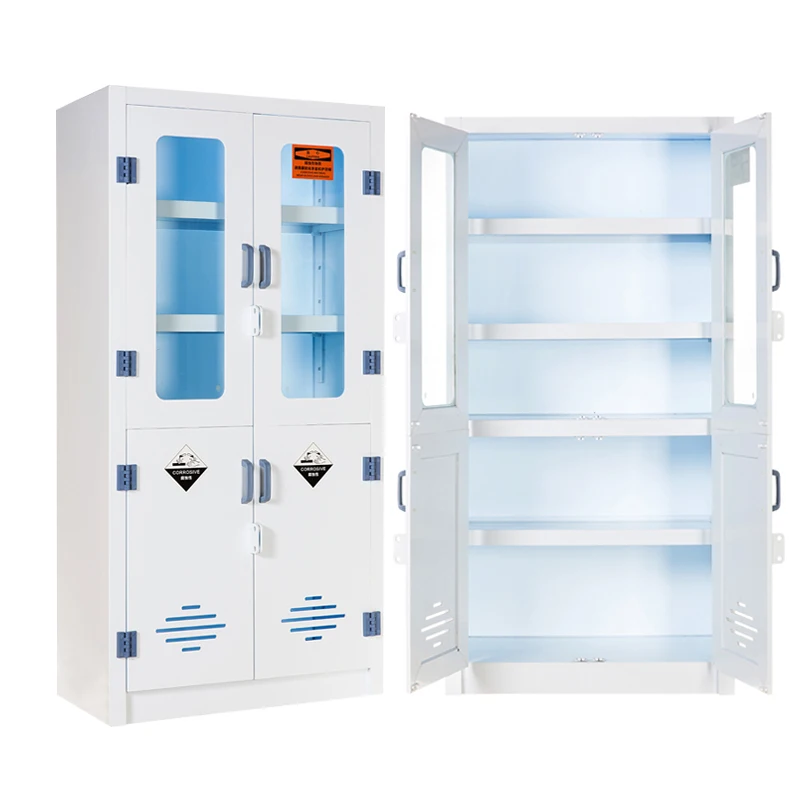
Compare available polypropylene and metal cabinet records before sending a chemical list for review.
Buyer questions
Answers define the next check; they do not replace the SDS, facility review or selected-model documents.
Chemical behavior and recommended storage conditions can change with concentration and formulation. SDS Section 7 is a starting point.
They are commonly separated. Review the exact chemicals, incompatibilities and facility storage plan before choosing cabinets.
No. Material selection depends on the chemical, concentration, exposure route, container and project requirements.
Do not assume so. Oxidizing acids can have incompatibilities within the broader acid category; use the SDS and facility guidance.
Include chemicals, concentrations, bottle sizes, quantities, preferred containment, available space, destination and required documents.
Safatrix can respond about listed product information. Final compatibility, segregation and site approval remain with qualified facility personnel.
Safety references
These external sources support storage questions. They do not certify a Safatrix model or replace local code and facility approval.
Product files
Send the model, quantity, destination country and required drawings or documents.
RFQ intake
Email the cabinet family, stored item, quantity, destination country and required documents, or contact Safatrix on WhatsApp for a quick product discussion.
Direct contact
Use email for product lists, drawings and document requests. Use WhatsApp for a quick discussion about models, quantities or customization.