Identify the gas service
Send the gas type and facility application.
 Request a Quote
Gas cylinder storage
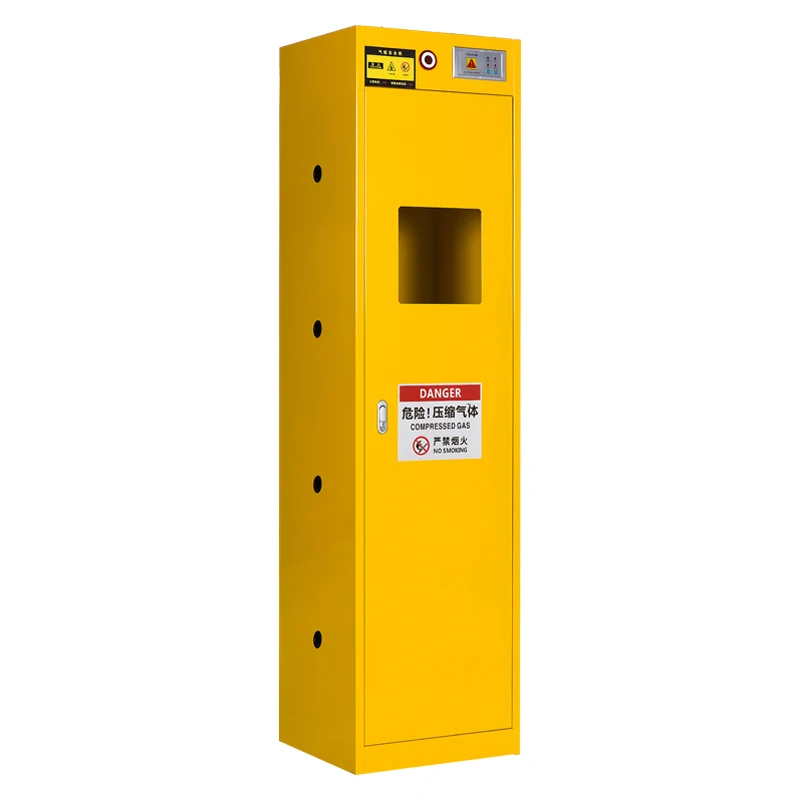
Compare laboratory and facility gas cylinder cabinet models by cylinder size, quantity, cabinet dimensions and monitoring requirements.
Provide the gas type, cylinder dimensions and number of cylinders. Detector, alarm, restraint and installation details must be confirmed for the selected model.
Decision path
The selected cabinet still depends on the stored material, dimensions, quantity and project documents.
Send the gas type and facility application.
Provide cylinder diameter, height and quantity per cabinet.
List detector, alarm and ventilation requirements.
Send the room location, access and required drawings.
Application fit
One or more cylinders serving analytical instruments within a planned indoor gas system.
Cylinders that require controlled access, restraint and coordination with room safety systems.
Process or calibration gases positioned near testing equipment under the facility gas plan.
Projects that specify enclosure, monitoring or exhaust interfaces for a defined gas service.
Configuration guide
These routes narrow the search. Confirm dimensions, construction and available features on the selected model.
Check cylinder diameter, height, valve clearance, restraint point and door access.
Confirm the exact cylinder arrangement and changeover space rather than relying on nominal count.
State the required sensing and control functions; verify availability on the selected configuration.
Provide project airflow and connection criteria; the cabinet does not design the room exhaust system.
Selection conditions
Use the table to compare cabinet routes before choosing a model. Final chemical compatibility and site approval remain part of the facility review.
Scope
Use another route when
Common mistakes
Capacity labels do not confirm diameter, valve, regulator or restraint clearance.
Gas hazards affect the site review, monitoring and separation requirements.
Detector, alarm and shutoff features must be confirmed for the selected configuration.
Cylinder handling, piping, ventilation and emergency controls extend beyond the enclosure.
Product route
Compare available models and send cylinder dimensions, quantity and monitoring requirements with your RFQ.
Buyer questions
Answers define the next check; they do not replace the SDS, facility review or selected-model documents.
Send cylinder diameter, total height, valve or regulator clearance and the number of cylinders per cabinet.
Requirements depend on the gas, quantity, room and facility design. State the required functions so the model configuration can be checked.
Do not assume it does. Confirm cabinet openings or connections and coordinate the exhaust system with the project engineer.
That decision requires gas-specific compatibility, separation and facility review; a cabinet size alone cannot answer it.
It sets general requirements for compressed-gas cylinder inspection, handling, storage and use through referenced provisions. Project-specific standards may also apply.
Request model dimensions, internal layout, restraint details and available detector, alarm or exhaust interface information.
Safety references
These external sources support storage questions. They do not certify a Safatrix model or replace local code and facility approval.
Product files
Send the model, quantity, destination country and required drawings or documents.
RFQ intake
Email the cabinet family, stored item, quantity, destination country and required documents, or contact Safatrix on WhatsApp for a quick product discussion.
Direct contact
Use email for product lists, drawings and document requests. Use WhatsApp for a quick discussion about models, quantities or customization.